<
>

Don't let a rare part be the end of your bike's story. We re-engineer and 3Dprint the spare parts you can't find anywhere else.
Preservering through R3-engineering
<
>
Don't let a rare part be the end of your bike's story. We re-engineer and 3Dprint the spare parts you can't find anywhere else.
Preservering through R3-engineering
3D printing for classic motorcycles: how SLS technology recreates NLA parts
Written by: Martin | Founder of R3print Moto Last updated: 13-5-2026
Classic motorcycle restoration has always involved a certain amount of searching. Not just for complete bikes, but for the small plastic components that quietly disappear over time. A cracked side panel. A broken intake duct. A missing battery cover. Usually, it’s not the engine that stops a restoration project. It’s a single discontinued plastic part that manufacturers stopped producing decades ago.
This is why 3D printing has become an essential tool in modern motorcycle restoration. As more restorers begin recreating discontinued parts digitally, different manufacturing technologies have started finding their place within the industry. One of these methods is SLS.

What is SLS 3D printing?
SLS stands for Selective Laser Sintering. Unlike traditional filament-based printing (FDM), SLS uses a high-powered CO2 laser to fuse fine nylon powder into a solid part, layer by layer, inside a heated powder bed.
One of the primary engineering advantages of this process is that the surrounding unsintered powder naturally supports the component during the build. This means parts can be produced without the mechanical support structures normally required in FDM printing.
This provides significant geometric freedom. Complex internal channels, thin organic wall sections, intricate ducts, and flexible snap-fit features can often be manufactured much more efficiently through SLS than through conventional filament printing. The finished parts also exhibit a uniform matte surface finish and isotropic mechanical properties, meaning they have consistent strength in all directions. Critical for parts under high vibration.
How does SLS 3D printing work?
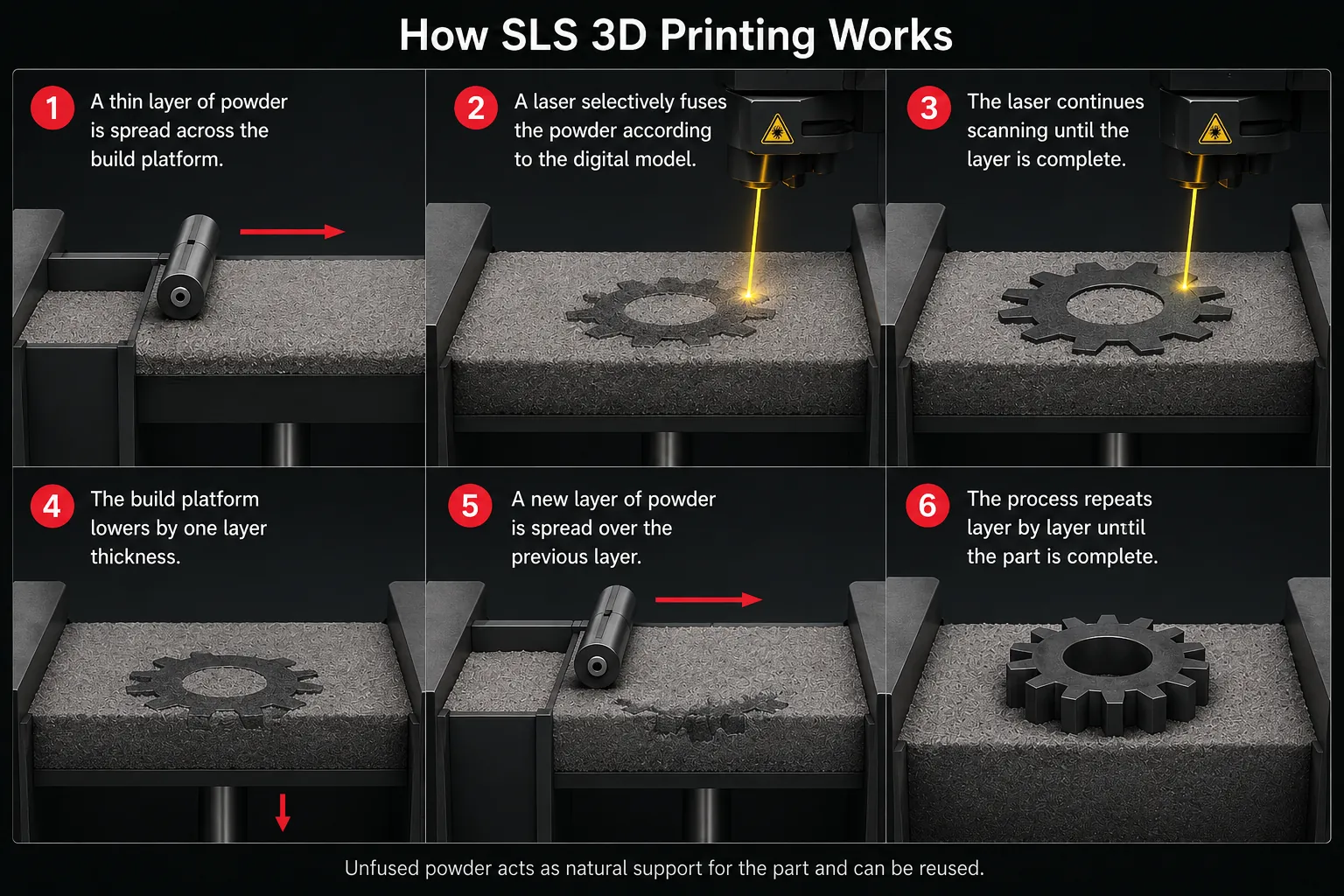
Selective Laser Sintering (SLS) is a “powder bed fusion” process that operates differently than standard filament printing. Rather than extruding plastic through a nozzle, it uses a high-heat environment to build parts within a “cake” of nylon powder.
The process begins as a counter-rotating roller spreads an ultra-thin layer of powder onto a platform inside the build chamber. As can be seen in the image above. To ensure precision, the printer preheats the powder to a temperature slightly below the melting point of the raw material. This thermal management makes it easier for the laser to raise the temperature of specific regions as it traces the digital model to solidify the part..
A focused CO2 laser scans a cross-section of the 3D model, heating the powder to the exact melting point of the material. This fuses the particles together mechanically to create one solid part based on our digital blueprints.
Once a layer is complete, the platform lowers by one layer (typically between 50 to 200 microns) and the cycle repeats. Because the unfused powder remains in the bed, it supports the part during printing and eliminates the need for dedicated support structures. This allows for the complex, organic geometries often found in NLA motorcycle parts.
After the build is complete, the chamber must cool down slowly – first inside the enclosure and then outside the printer. This gradual cooling is essential to ensure optimal mechanical properties and to avoid any warping in the parts.
The finished parts are “excavated” from the build chamber, separated, and cleaned of excess powder. While the leftover powder is recycled for future use, the printed components are finished via media blasting or tumbling. This results in a durable, matte finish that mimics the look and feel of original factory plastics.
Why SLS works well for motorcycle parts
Many vintage motorcycle plastics were originally injection molded with complex, non-linear shapes. Airbox ducts curve through tight spaces, and fairing internals use thin, ribbed structures for stiffness. Clips and mounting tabs often rely on specific snap-fit behavior that becomes difficult to reproduce with traditional manufacturing.
This is exactly where SLS excels. Because the powder bed fully supports the part, SLS can produce shapes that would otherwise require extensive supports or difficult print orientations in FDM. It is especially useful for:
Complex Intake Ducts: Recreating internal airflow geometries without support scarring.
Thin-Walled Fairing Internals: Maintaining structural rigidity in lightweight parts.
Snap-Fit Housings: Utilizing the natural fatigue resistance of Nylon 12.
Organic OEM-Style Geometries: Matching the “as-cast” look of factory plastics.
Intricate Routing Components: Managing cables and fuel lines in tight tolerances.
The nylon materials used in SLS printing offer excellent durability, impact resistance, and thermal stability, which is vital for real-world motorcycle use near heat sources like engines and exhausts.
Where FDM still makes more sense
Despite the advantages of SLS, it is not automatically the superior solution for every motorcycle part. In reality, the majority of our production work at R3print Moto is still performed using FDM (Fused Deposition Modeling).
Modern industrial FDM systems have improved significantly. By utilizing engineering-grade, fiber-reinforced materials like PA12-CF (Carbon Fiber Reinforced Nylon) or TPU FDM is capable of producing extremely rigid and durable functional parts.
For restoration work specifically, FDM offers several practical advantages:
1. Rapid iteration and flexibility
When reverse engineering 40-year-old components, adjustment is almost always necessary. Original plastics warp, mounting holes shift between production years, and vintage tolerances were often imprecise. The ability to quickly print, test-fit, revise, and reprint a component is an invaluable part of the engineering cycle.
2. Specific tensile strength
For structural parts like battery trays, brackets, or heavy mounting tabs, the directional strength provided by fiber-reinforced FDM filaments can often outperform unreinforced SLS nylon powder in specific load-bearing orientations.
3. Practicality for one-off parts
FDM is significantly more efficient for “bespoke” restoration where only a single unit is required. It allows us to maintain a digital library that can be deployed instantly without the setup overhead of industrial SLS runs.
FDM vs SLS in real reproduction work
It might seem like SLS and FDM are competing technologies, with one being “better” than the other. In practice, that really isn’t the case. FDM and SLS complement each other extremely well, and both technologies excel at different types of parts.
For many motorcycle components, such as brackets, electrical housings, battery trays and mounting tabs, FDM remains the most practical and cost-effective solution. Modern engineering-grade nylon filaments are incredibly capable, especially for functional restoration parts where strength, rapid iteration and low-volume production matter most.
SLS becomes the preferred option when a part benefits from the unique advantages of powder-bed manufacturing, such as:
- Thin organic wall structures
- Complex internal geometry
- Flexible long-term snap-fit features
- Parts with demanding cosmetic requirements and minimal visible layer lines
For every motorcycle component we reproduce, we evaluate which manufacturing method is best suited for the application. Depending on the geometry, strength requirements, finish quality, and production volume, that may involve FDM, SLA, or SLS printing.
Each technology has its own strengths and trade-offs, which is why we don’t force projects into a single manufacturing process simply because it can be done in-house. For example, SLS production is outsourced to specialized manufacturing partners whenever a project genuinely benefits from the process.
Why we outsource SLS production
While most development and structural production happens in-house through FDM nylon printing, SLS production is outsourced to specialized industrial partners whenever a project genuinely benefits from the process.
Industrial SLS systems operate very differently from FDM printers and are optimized for specialized production environments. By working with dedicated SLS manufacturing partners, we can remain flexible while still choosing the best production method for each individual component.
That hybrid workflow allows us to balance engineering, durability, finish quality, and manufacturing efficiency depending on the specific reproduction project.
Frequently asked questions
Q: What is SLS 3D printing?
A: SLS (Selective Laser Sintering) is a manufacturing process that uses lasers to fuse nylon powder into durable functional parts.
Q: Is FDM strong enough for motorcycle parts?
A: Yes. Especially when using engineering-grade nylon materials like ASA, TPU or carbon fiber infused Nylon. Proper design and print orientation are critical.
Q: Why not use SLS for everything?
A: SLS offers advantages for certain geometries and surface finishes, but FDM is often faster, more affordable, and better suited for one-off restoration parts.
Q: What motorcycle parts work best with FDM?
A: Brackets, housings, battery trays, airbox components, mounts, and many functional restoration parts are excellent candidates for FDM nylon printing.
Q: What motorcycle parts benefit most from SLS?
A: Thin-walled components, snap-fit parts, complex ducts, and highly organic OEM-style geometries are often good candidates for SLS.
Q: Can 3D printed parts survive real riding conditions?
Q: Is 3D printing replacing traditional restoration?
A: No. It’s simply another tool that allows restorers to recreate parts that no longer exist through conventional supply channels.
Need a part?
Now that you know how SLS 3D printing can restore classic motorcycle parts, let’s get your bike back on the road. We can reproduce parts from our archive or re-engineer them.